
grandmark logoGrandmark International
@alexaseleno
Skip to main content

2026 Top Boat Ratchet Straps Buying Guide for Buyers

Choosing Boat Ratchet Straps is about more than finding a strong-looking buckle. The right set helps secure a boat during trailering, but poor sizing or unsuitable hardware can create avoidable risks. This 2026 buying guide explains the details buyers should compare before making a purchase.

Start with the strap’s labeled working load limit, not just its breaking strength. These figures describe different things. Check the boat and trailer manufacturers’ guidance, then consider the load, tie-down points, and number of straps needed. A larger rating is not automatically the best choice if the strap cannot be routed correctly.

Material matters, too. Polyester webbing is commonly chosen for its low stretch, while coated or corrosion-resistant hardware may suit frequent exposure to water. Still, no coating makes a strap immune to wear. Salt, grit, sharp edges, and sun can shorten its service life. Small details matter. Look for clear labels, smooth ratchet action, secure hooks, and a length that reaches the anchor points without excessive slack.

A buying guide cannot judge every product in person, and product specifications do not tell the whole story. Inspect straps before use, follow the manufacturer’s instructions, and replace any showing cuts, fraying, damaged stitching, or distorted hardware. That sounds cautious. It is. Comparing fit, rating, materials, ease of adjustment, and storage needs will help buyers choose Boat Ratchet Straps that suit their boat and routine, rather than relying on appearance or price alone.
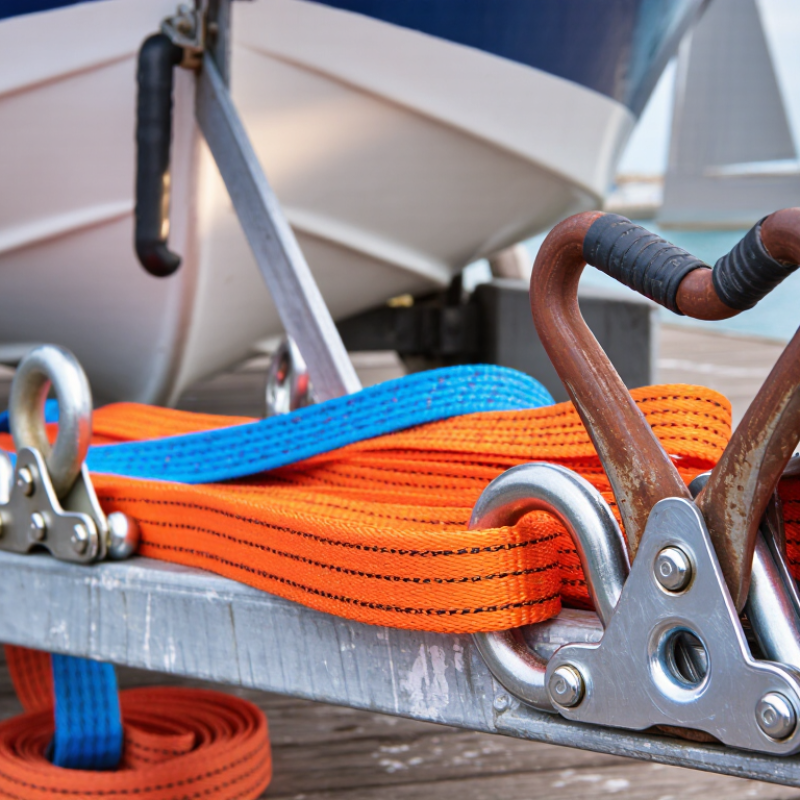
2026 Top Boat Ratchet Straps Buying Guide for Buyers

Boat Ratchet Strap Basics: Working Load Limit, Breaking Strength, and Safety Factor

A boat ratchet strap’s working load limit (WLL) is the maximum load it is rated to handle in normal use. Breaking strength is the force at which the strap may fail under test conditions. They are not interchangeable. A large breaking-strength number does not make that the safe working capacity.

The safety factor is the relationship between breaking strength and WLL, but its value can vary by product and construction. Use the marked WLL for planning, and follow the strap maker’s instructions rather than calculating a higher capacity yourself. Boat weight alone does not tell you the load on each strap; hull shape, tie-down angles, and movement during transport all matter. Keep the strap angles sensible and distribute restraint across suitable points.

Small details matter. Before tightening, check the label, stitching, ratchet teeth, and hooks for damage or corrosion. On a wet ramp, grit can hide in webbing folds and wear the fibers against a sharp edge. Use edge protection where contact could abrade the strap. I still find it easy to focus on the ratchet and overlook the anchor point. Inspect both. Replace any strap with cuts, melted fibers, unreadable ratings, or a mechanism that slips; appearance alone can be misleading.

Calculate Capacity: FMCSA Sets Aggregate WLL at 50% of Cargo Weight

2026 Top Boat Ratchet Straps Buying Guide for Buyers

Calculate Capacity: FMCSA Sets Aggregate WLL at 50% of Cargo Weight

When securing a boat for road transport, start with its loaded weight. FMCSA rules generally require the tiedowns’ aggregate working load limit (WLL) to equal at least half the cargo’s weight. For a 2,000-pound boat, that means at least 1,000 pounds of aggregate WLL. Add the WLL ratings shown on the strap labels, not their breaking strengths. A strap’s bright color or heavy-looking webbing does not prove its capacity.

Choose ratchet straps that meet the calculated minimum and suit the boat’s tie-down points. Check labels for readable ratings, inspect stitching and hardware, and avoid straps with cuts, fraying, bent hooks, or corrosion. Wet launches and salty air can speed up wear. Keep hooks clear of delicate hull edges, and use padding where webbing could rub. A number on paper is not enough; placement and tension matter too.

Tips: Recheck each strap after the first short drive, then at stops. Make sure the boat cannot shift, and follow trailer and boat-maker instructions. I’d still pause over an awkward tie-down angle; a strap can meet the math and remain poorly positioned. Don’t guess—adjust the setup or seek qualified guidance.

Choose Webbing: EN 12195-2 Limits Elongation at Lashing Capacity to 7%

When choosing boat ratchet straps, check the webbing’s stated elongation at lashing capacity (LC). EN 12195-2 limits this elongation to 7% at LC. This figure describes stretch under a specified load; it is not a promise that a loaded boat will move by exactly 7%. The full setup matters.

Look for a clear, durable label showing LC, and compare it with the restraint needs of your boat and trailer. A compliant strap with lower elongation can help limit slack as the load settles on a bumpy road. Still, tightness alone is not enough. Place webbing over broad, suitable contact points, and use edge protection where it crosses a sharp hull fitting. Small details matter.

Check the strap after wet storage, salt spray, or contact with grit. Rinse and dry it, then inspect for fraying, cuts, faded labels, or damaged stitching. Replace doubtful webbing. That can feel wasteful, but a strap’s appearance may hide weakened fibers. EN 12195-2 is a useful buying benchmark, not a substitute for checking the strap’s condition or securing the boat correctly.

2026 Top Boat Ratchet Straps Buying Guide for Buyers - Choose Webbing: EN 12195-2 Limits Elongation at Lashing Capacity to 7%
Buying Dimension What to Look For Why It Matters Buyer Check
Standard and webbing elongation For textile lashing assemblies covered by EN 12195-2, the webbing elongation at lashing capacity (LC) is limited to 7%. Lower webbing stretch helps limit movement as a secured load is subjected to transport forces. The 7% figure is a maximum, not a promise that every strap stretches by that amount. Check the product documentation and label for the applicable standard and the webbing’s stated elongation at LC.
Lashing Capacity (LC) Choose an assembly with a clearly marked LC appropriate to the securing arrangement and the boat’s transport conditions. LC is commonly marked in daN. LC describes the rated lashing strength of the assembly. It is not the same as the ratchet’s tightening force or a lifting capacity. Use the vehicle, trailer, and cargo-securing requirements to determine the needed capacity; do not select by strap width alone.
Standard Hand Force (SHF) and Standard Tension Force (STF) Look for the SHF and STF values on the label or technical documentation. SHF is the reference hand force; STF indicates the standard tension force produced by the ratchet under the stated test conditions. These values help buyers compare pretensioning performance. STF is not interchangeable with LC. Compare clearly documented values and follow the manufacturer’s operating instructions. Do not assume that applying more handle force is safe.
Webbing material Polyester webbing is commonly used for lashing straps. Check the material specification and any stated environmental or care limitations. Material affects stretch, handling, and service life. Boat transport can expose straps to moisture, sunlight, dirt, and salt residue. Inspect webbing regularly and rinse off salt or grime when appropriate. Replace straps with cuts, burns, heavy abrasion, damaged stitching, or unreadable labels.
Strap width and length Widths such as 25 mm, 35 mm, and 50 mm are commonly available, but capacity depends on the complete rated assembly. Select a length that reaches the proper anchor points without excessive loose webbing. The strap must fit the boat, trailer, and attachment points while allowing the ratchet to operate correctly. Measure the required routing path and check the marked LC of the finished assembly, including its end fittings.
Ratchet and end fittings Check the ratchet body, handle, stitching, and fittings for secure construction, smooth operation, and compatibility with the trailer’s rated anchor points. A strap is only as suitable as its complete assembly and connection points. Corrosion or deformation can compromise safe use. Confirm that hooks or other fittings cannot slip off or damage the attachment point. Keep metal parts clean and inspect them for corrosion or distortion.
Boat contact and edge protection Use suitable protective sleeves, pads, or edge protection where webbing contacts sharp edges or delicate boat surfaces. Chafe and concentrated pressure can damage both the webbing and the boat’s finish or structure. Route straps away from sharp corners, hoses, cables, and fragile components. Recheck contact points after tensioning.
Application and safe use Use ratchet lashing straps for securing cargo during transport, not for lifting. Secure the boat at suitable points and follow applicable local transport rules. Correct lashing arrangements depend on the load, anchor points, and transport forces; a strap rating alone does not establish a complete securing plan. Follow the boat and trailer instructions, secure loose equipment, stow excess webbing, and recheck tension during the journey where safe to do so.

Match Strap Length, Ratchet, and End Fittings to Trailer Tie-Down Points

2026 Top Boat Ratchet Straps Buying Guide for Buyers

Match each strap to the actual distance between its trailer tie-down point and the boat’s secure attachment point. Measure the path, not just the straight-line gap; a strap that barely reaches may leave the ratchet crowded against a rail. Too much extra webbing can flap, drag, or foul nearby hardware. Fit matters. Choose a ratchet with enough handle clearance to tighten fully without striking the hull or trailer. Select end fittings that seat fully in the tie-down eyes or rails, and avoid hooks that can twist or load sideways.

Check the strap’s working load limit (WLL), not only its breaking strength. The Federal Motor Carrier Safety Administration’s cargo-securement guidance uses an aggregate WLL of at least 50% of cargo weight for covered loads. That is a useful reference point, not a substitute for your trailer and boat manufacturers’ instructions. Inspect stitching, webbing, and ratchet teeth; cuts, glazing, or corrosion are reasons to replace a strap. One easy-to-miss detail: sharp edges can damage webbing even when the strap rating looks adequate.

Tips: Before towing, tighten each strap, close the ratchet handle, and check that the fittings remain seated after a short test drive. Recheck tension. A little slack can matter.

Check Labels and Inspect Webbing, Stitching, and Hardware Before Each Trip

Before loading, read each strap label in good light. Confirm its working load limit, length, and any care instructions. Do not confuse working load limit with break strength. The restraint system’s capacity depends on its components and setup, so follow the boat and trailer guidance too. If a label is missing or unreadable, set that strap aside until you can identify it.

Run the webbing slowly through your hands. Look for cuts, frayed edges, stiff patches, melted spots, or fading that may point to sun damage. Check the stitching near hooks and sewn loops for loose or broken threads. A small snag can be easy to dismiss. Don’t. I have rushed past one before, and it took a second look to notice the damaged edge.

Inspect hooks and ratchets for rust, bends, cracks, or sharp burrs that could cut the webbing. Work the handle and release; both should move without sticking. Clear away grit and let wet straps dry before storage. If any part looks questionable, replace the strap or ask the maker for advice rather than patching it yourself. Give the whole set another quick check before every trip, including straps kept as spares.

2026 Boat Ratchet Strap Pre-Trip Inspection Checklist

Checklist items to verify before each trip, grouped by strap component. Counts show the checks listed here—not failure rates or a substitute for the strap’s load-rating label or manufacturer instructions.