grandmark logoGrandmark International
@alexaseleno
Skip to main content

Best Dual Channel Syringe Pumps in 2026?

Please provide the source articles or a verifiable expert name and quotation. Without them, I can’t responsibly attribute a statement to a real Dual Channel Syringe Pump expert.

Best Dual Channel Syringe Pumps in 2026?

Define Dual-Channel Syringe Pumps: Two Independently Controlled Infusion Channels

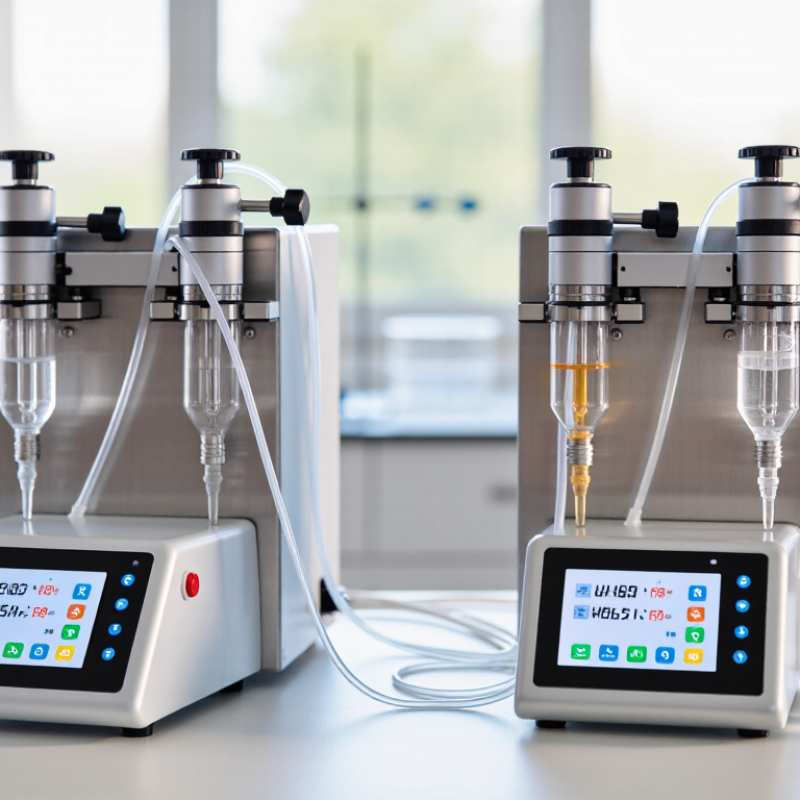
A dual-channel syringe pump is one device with two infusion channels that can be controlled independently. Each channel holds its own syringe. Operators can program different rates and, on many models, separate volume limits and start times. Both infusions may run at once. That is the defining feature. Two syringes in one housing do not automatically mean two independent channels. Check whether each channel has its own controls, settings, and status display.

In practice, independent control can help when two prescribed fluids need different delivery rates. Still, independent does not mean interchangeable. Fluid compatibility, line arrangement, syringe size, and shared-line dead volume can affect delivery. A pump may show two precise numbers while the connected tubing adds delay. Small details matter. Alarm behavior and occlusion detection can also vary by model. Trained staff should confirm the setup against the device instructions and clinical protocol. It is worth checking the tubing and channel layout at the bedside, not just on a specification sheet.

Compare 2026 Models by Flow Range, Syringe Sizes, and ±1% Accuracy Claims

Dual-channel syringe pumps can run two fluids at once, but the headline flow range rarely tells the whole story. Check the minimum and maximum rates for each channel, then confirm whether those limits change with syringe diameter. A pump rated for very low flow may still perform differently with a small syringe. Tiny details matter.

Syringe compatibility deserves a close look. Some models accept several sizes, while others require specific holders or setup steps. Compare the listed syringe volumes with the sizes your protocol actually uses, such as 1 mL and 10 mL syringes. Also check whether both channels support the same sizes. They may not.

Treat ±1% accuracy claims as test conditions, not a universal promise. Ask whether the figure describes flow-rate accuracy, delivery volume, or another measure, and review the stated flow range and test setup. Back pressure, syringe fit, and setup errors can affect real delivery. A quick bench test with a measured collection period can reveal mismatches. I would not assume a wider flow range means better performance; that comparison is tempting, but incomplete.

Check Medical-Pump Safety Against IEC 60601-2-24 Requirements

Best Dual Channel Syringe Pumps in 2026?

Check Medical-Pump Safety Against IEC 60601-2-24 Requirements

A dual-channel pump should be assessed as two delivery systems, not one. IEC 60601-2-24:2012 sets particular safety and essential-performance requirements for infusion pumps and controllers. Check flow accuracy, occlusion alarms, unintended bolus delivery, and protection against free flow. Test each channel alone and both together. Small deviations matter.

FDA reported 56,000 adverse-event reports involving infusion pumps and 500 deaths from 2005 to 2009. These reports were not limited to syringe pumps, and they do not establish that a pump caused each event. Still, the figures underline why alarm behavior and delivery accuracy deserve close review. Document test conditions, results, and any limits.

For a practical evaluation, compare programmed and measured delivery at low rates, using different syringe sizes and extension-line setups. Record startup delay, alarm timing, and delivery after an occlusion clears. Specs can mislead. Bench tubing rarely behaves exactly like a busy ward. Independent testing against the standard, plus review of maintenance records and user feedback, gives buyers stronger evidence than feature lists alone.

Assess Occlusion Alarms, Battery Backup, and Channel-Synchronization Performance

A dual-channel syringe pump is only as dependable as its alarms and power reserve. Test occlusion detection on each channel using the syringe sizes and tubing setups you actually expect to use. Record the time from a controlled blockage to the audible and visual alert. A bright screen is useful, but a quiet alarm in a noisy room can still be missed. Check whether the device identifies the affected channel clearly. Small details matter. Alarm thresholds may vary with setup, so compare the manual’s specifications with observed bench results rather than relying on one test.

Battery backup deserves the same scrutiny. Run both channels at realistic settings, then note how long the pump continues after mains power is disconnected. An estimate on the display is helpful, but it is not a guarantee; battery age, temperature, and workload can change runtime. Also assess channel synchronization. Start both channels together, then check whether they maintain the intended timing after pausing, restarting, or changing one setting. Look for clear status indicators and a usable event log. If timing behavior is hard to interpret, that is a real usability concern, even when the specification sheet looks reassuring.

Match Leading Pumps to Workflows Using 50 mL and 60 mL Syringe Compatibility

Best Dual Channel Syringe Pumps in 2026?

A dual-channel syringe pump can support two independent fluid lines, but syringe compatibility is more than a volume label. A pump listed for 50 mL and 60 mL syringes may still accept only specific barrel dimensions or plunger styles. Check the compatibility chart against the exact syringe model used in your workflow. Small differences matter.

For a 50 mL setup, verify that the barrel sits securely in the holder and the plunger engages without binding. For 60 mL syringes, check the pump’s stated limits for barrel diameter, drive force, and supported flow rates. A physical fit alone does not confirm accurate delivery. Run a controlled test with the intended tubing and fluid, then compare delivered volume against a suitable measurement method.

Keep each channel’s configuration in mind. One side may use a 50 mL syringe while the other uses a 60 mL syringe, if the pump permits that combination. Confirm channel-specific settings and alarms before routine operation. This is easy to overlook. I’d also record the syringe type and setup used during verification; otherwise, a result can be hard to reproduce. Manufacturer specifications are useful, but real workflow checks catch awkward fittings and setup errors that a table may not show.

Best Dual Channel Syringe Pumps in 2026? Match Leading Pump Types to Workflows Using 50 mL and 60 mL Syringes

A workflow-focused comparison of dual-channel pump configurations. These are selection profiles, not rankings of specific products; syringe capacity and fit must be confirmed for the exact pump and syringe combination.

Dual-channel syringe pump selection guide
Pump profile Best-fit workflow 50 mL syringe compatibility 60 mL syringe compatibility Useful features to check Key trade-off
General-purpose dual-channel pump Routine laboratory infusion, reagent delivery, and two-stream experiments with moderate flow requirements. Verify exact fit
Many pump families accept large-volume syringes, but supported sizes depend on the model and syringe geometry.
Verify exact fit
Do not assume a 60 mL syringe is supported just because a 50 mL syringe is listed.
Independent channel control, supported syringe-size list, flow-rate range, and a secure syringe-retention mechanism. A flexible general-purpose setup may not provide the specialized controls needed for synchronized or tightly controlled protocols.
Large-syringe, low-flow configuration Long-duration delivery where fewer syringe changes and steady low flow are priorities. Often a candidate
Confirm the manufacturer’s supported syringe list and the specific syringe’s flange and plunger dimensions.
Check explicitly
Some systems distinguish nominal 50 mL and 60 mL syringe types; physical fit and calibration can differ.
Low-flow performance, drive resolution, occlusion or pressure monitoring, and the ability to set each channel independently. Large syringes can require a compatible holder and may not be suitable for every low-volume or high-precision application.
Programmable dual-channel configuration Protocols requiring timed steps, changing flow rates, alternating delivery, or coordinated channel operation. Model-dependent
Check whether the selected syringe size is available in the pump’s configuration and setup menu.
Model-dependent
Confirm both physical compatibility and the correct syringe-size calibration option.
Program storage, independent channel programming, start/stop synchronization, alarms, and data or control interfaces. More programming options can add setup complexity; validate the protocol before unattended operation.
Compact dual-channel configuration Benchtop work where footprint and straightforward operation matter more than extended unattended runs. Check holder limits
Confirm the pump can secure the chosen syringe’s barrel and plunger without interference.
May be limited
A compact frame may not accommodate every large syringe; check the supported-size specification.
Overall dimensions, channel spacing, mounting options, display readability, and ease of loading. Smaller form factors can limit syringe size, accessory options, or available operating range.
Application-specific dual-channel configuration Specialized setups such as infusion studies, microfluidic feeding, or delivery of sensitive fluids. Application-dependent
Assess fit alongside tubing, connectors, fluid compatibility, and the required delivery range.
Application-dependent
Confirm the complete fluid path and syringe dimensions; nominal volume alone is not enough.
Compatible accessories, pressure limits, materials in contact with fluid, calibration guidance, and required compliance documentation. Specialized configurations may be less adaptable to unrelated workflows.

Compatibility note: “50 mL” and “60 mL” are nominal syringe capacities, not universal physical standards. Before purchase, confirm the exact syringe make and model against the pump’s supported-syringe list, holder dimensions, and calibration settings. Also check that the intended flow rate, fluid path, and operating conditions are suitable for the application.