@alexaseleno

China’s automotive electrical sector has become a critical link in global vehicle manufacturing. It supplies wiring harnesses, connectors, sensors, relays, control units, and power electronics. These components may look small, yet one loose terminal can stop an entire production line.
This guide examines ten notable Chinese suppliers serving passenger cars, commercial vehicles, and new energy platforms. It considers manufacturing experience, product specialization, research investment, quality systems, delivery capability, and international cooperation. Public company records, official product information, factory data, and industry references provide the basis for comparison. Where evidence is limited, that limitation is stated clearly.
The selected companies represent different strengths. Some focus on high-voltage systems for electric vehicles. Others specialize in low-voltage wiring, printed circuit boards, lighting controls, or thermal management electronics. Their facilities may include automated crimping lines, electrical testing benches, clean assembly rooms, and traceability systems linked to individual components.
Details matter.
However, no supplier ranking is perfectly neutral. A large revenue figure does not always indicate better engineering support. A modern factory does not guarantee consistent service in every market. Buyers should verify certifications, sample performance, warranty terms, production capacity, and after-sales response before making a decision. This article offers a practical starting point, not a substitute for technical audits or direct supplier discussions. It also reflects a changing market, where automotive electrical technologies develop faster than many published company profiles.
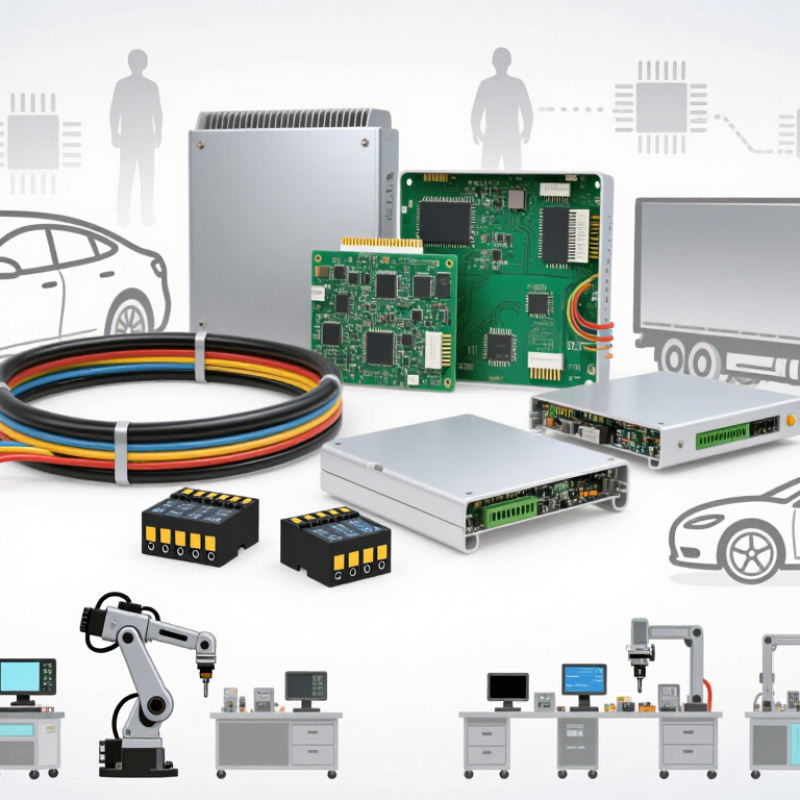
China Top 10 Automotive Electrical Suppliers
Automotive electrical suppliers in China provide the components that distribute, control, sense, and store vehicle energy. Their scope includes wiring harnesses, connectors, sensors, electronic control units, power semiconductors, batteries, traction motors, and charging equipment. Some suppliers also develop embedded software and thermal management systems. The boundary is not perfectly clean.
Market data explains this broad definition. The China Association of Automobile Manufacturers reported 30.16 million vehicle production units in 2023. The International Energy Agency stated that China sold more than eight million electric cars that year, representing over 60% of global electric car sales. These figures show why electrical capability now affects nearly every vehicle category. It is no longer limited to electric cars.
For a “top 10” evaluation, company size alone is insufficient. Buyers should examine production traceability, failure analysis, testing capacity, and delivery stability. Practical checks include connector corrosion tests, harness pull-force records, software validation, and high-voltage safety procedures. IATF 16949 certification supports process discipline, while ISO 26262 practices help assess functional safety. Still, certificates do not guarantee consistent field performance. A credible review should compare audited evidence, customer application experience, and defect data. Supplier categories may overlap, and ranking methods can remain imperfect.
| No. | Automotive Electrical Supplier Segment | Typical Products and Services | Primary Vehicle Applications | Relevant Technical Scope | Common Qualification and Compliance Requirements |
|---|---|---|---|---|---|
| 1 | Low-Voltage Wiring Systems | Vehicle wire harnesses, branch harnesses, terminals, connectors, clips, seals and fuse-box assemblies | Passenger vehicles, commercial vehicles, buses and specialty vehicles | Generally 12 V or 24 V vehicle electrical networks; conductor and cable requirements commonly reference ISO 19642 and ISO 6722 | Dimensional accuracy, terminal crimp-force control, sealing performance, vibration resistance and traceability |
| 2 | High-Voltage Battery Wiring Systems | High-voltage cables, shielded connectors, busbar assemblies, service disconnects and battery interconnects | Battery electric vehicles, plug-in hybrid vehicles and hybrid vehicles | Typical traction systems range from several hundred volts to approximately 800 V; insulation, shielding and touch protection are essential | Electrical isolation, dielectric withstand, electromagnetic shielding, ingress protection and requirements related to UN Regulation No. 100 |
| 3 | Automotive Connectors and Terminals | Board-to-board connectors, wire-to-wire connectors, sealed connectors, terminals and connector housings | Body electronics, powertrain, chassis, safety systems and infotainment | Low-current signal circuits, high-current power circuits and high-voltage interconnection systems | Contact resistance, retention force, mating-cycle durability, vibration resistance, temperature cycling and water or dust protection under IEC 60529 where applicable |
| 4 | Power Distribution and Protection Systems | Junction boxes, power distribution units, fuse boxes, relays, circuit breakers and busbar modules | Passenger cars, trucks, buses and electric commercial vehicles | Protection and distribution of low-voltage or high-voltage electrical power across multiple vehicle circuits | Current-carrying capacity, thermal performance, short-circuit protection, insulation coordination and enclosure safety |
| 5 | Battery Management and Battery Electrical Assemblies | Battery monitoring units, cell-sensing harnesses, busbars, current sensors and battery junction assemblies | Electric and hybrid vehicle battery packs | Cell-voltage monitoring, temperature sensing, current measurement, balancing and high-voltage isolation monitoring | Functional safety processes aligned with ISO 26262, electrical safety, thermal management compatibility and abuse-test support |
| 6 | Electronic Control Units and Domain Controllers | Body control units, gateway modules, chassis controllers, powertrain controllers and domain computing hardware | Connected vehicles, electric vehicles and conventional vehicles with distributed electronic architectures | CAN, LIN, FlexRay and Automotive Ethernet interfaces; embedded hardware and software integration | EMC testing, environmental reliability, cybersecurity engineering, software validation and ISO 26262 development processes |
| 7 | Electric Drive and Power Electronics | Inverters, onboard chargers, DC-DC converters, electric drive controllers and power modules | Battery electric, plug-in hybrid and hybrid vehicles | Conversion between battery, charging and motor-drive electrical domains; high-voltage switching and thermal control | Efficiency, power density, thermal cycling, electrical isolation, EMC performance and functional safety validation |
| 8 | Sensors and Actuator Electrical Modules | Pressure, temperature, position, speed, current and acceleration sensors, plus electrically controlled actuators | Engine, transmission, braking, steering, thermal management and battery systems | Analog and digital signal acquisition, vehicle network communication and closed-loop control | Measurement accuracy, drift, response time, vibration, temperature, humidity and chemical-resistance testing |
| 9 | Lighting and Signal Electrical Systems | LED lighting modules, lighting control units, exterior lamps, interior lamps and signaling assemblies | Passenger vehicles, commercial vehicles, buses and off-road vehicles | Low-voltage power supply, LED thermal management, optical performance and network-controlled lighting | Photometric performance, thermal durability, water ingress protection, EMC compliance and applicable road-vehicle lighting regulations |
| 10 | Charging, Communication and Telematics Electronics | Charging interfaces, charging control modules, telematics units, vehicle communication modules and antenna assemblies | Electric vehicles, connected vehicles and fleet vehicles | AC and DC charging control, cellular connectivity, GNSS positioning, Wi-Fi or Bluetooth connectivity and vehicle-network communication | Electrical safety, communication interoperability, EMC testing, cybersecurity controls, environmental durability and regulatory approval for the target market |
Scope note: The table presents ten major automotive electrical supplier segments in China rather than naming or ranking individual companies. Technical specifications vary by vehicle platform, customer requirements and target market.



Proud shareholder of Temot International

© 2025 Grandmark International. All rights reserved.