@alexaseleno

Choosing an auto air compressor is less about chasing the highest advertised pressure and more about matching the tool to the vehicle and the job. A compact 12-volt inflator can handle occasional top-ups, while a dual-cylinder unit may refill larger tires faster. Onboard compressors suit drivers who need a more permanent setup. Small differences matter: hose reach, gauge readability, duty cycle, and whether the unit can run from a vehicle outlet or battery.
Tire pressure provides the practical reason to compare these designs. In its 2007 report, The Effectiveness of TPMS in Proper Tire Pressure Maintenance, the U.S. National Highway Traffic Safety Administration found that vehicles with tire-pressure monitoring systems were 55.6% less likely to have one or more significantly underinflated tires. That finding concerns monitoring, not compressor performance. Still, it underscores why a dependable inflator and an accurate pressure check belong in the same conversation. A compressor is not a substitute for checking the vehicle maker’s recommended pressure.
This guide compares portable, twin-cylinder, and onboard auto air compressors by speed, power source, portability, and intended use. It also explains where digital inflators and heavy-duty models fit. No single type wins every time. A small inflator may be convenient but slow on a large tire; an onboard system adds capability but takes installation space. Real-world performance can differ from product claims, so specifications deserve a careful read. We’ll focus on the trade-offs that matter at the roadside and in the garage.
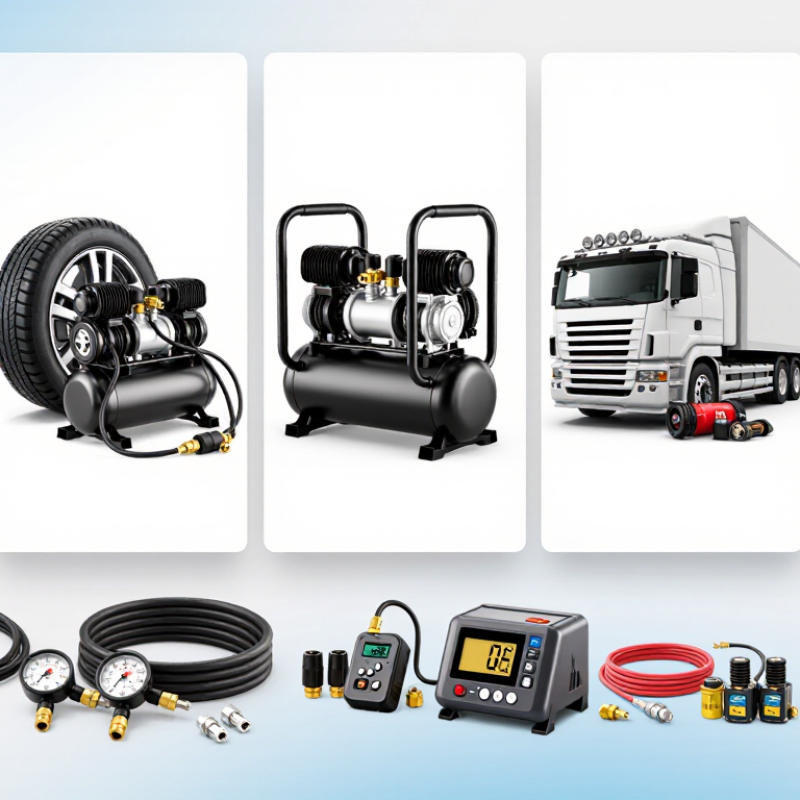
Automotive air compressors are commonly classified by their power source, installation, and compression mechanism. Portable 12-volt electric units draw power from a vehicle outlet or battery and usually serve tire inflation. They are compact, easy to store, and suited to occasional use. Small detail: check the rated duty cycle. A unit may need cooling breaks during repeated inflation.
Engine-driven compressors use mechanical power from the vehicle, while permanently installed electric systems operate from the vehicle’s electrical supply. These onboard designs can support air suspension or other pneumatic equipment, depending on their specifications. The categories overlap, which can make comparisons messy. Compressors are also grouped by mechanism: reciprocating piston models are common for compact applications, while rotary screw designs are generally associated with sustained air demand. Diaphragm compressors suit some specialized, lower-volume systems. Match the type to the required pressure, airflow, available space, and expected run time. A tire inflator and an onboard air system may both be called automotive compressors, but they do very different jobs. That distinction is easy to miss.
| Type | How It Is Powered | Typical Uses | Typical Operating Range | Main Advantages | Key Considerations |
|---|---|---|---|---|---|
| Portable 12-volt tire inflator | Vehicle battery or 12-volt accessory outlet; usually a compact piston pump. | Inflating passenger-car tires, bicycle tires, and some sports equipment with a suitable adapter. | Many models specify maximum pressures around 100–150 psi; airflow is limited and decreases as pressure rises. | Compact, easy to store, and convenient for roadside top-ups. | Often has a limited duty cycle and may need cooling breaks. Maximum pressure alone does not indicate inflation speed. |
| Portable high-volume inflator | Typically powered by a 12-volt battery connection; some units use a separate rechargeable battery. | Larger tires, off-road tire reinflation, and other tasks where airflow matters more than reaching very high pressure. | Pressure and airflow vary substantially by model; designed for tire inflation rather than continuous pneumatic-tool use. | Generally moves more air than a small emergency inflator and can better suit larger tires. | Requires adequate electrical capacity and ventilation. Check the stated duty cycle and connection requirements. |
| Onboard compressor with an air tank | Usually an electrically driven 12- or 24-volt compressor connected to a vehicle-mounted tank. | Repeated tire inflation, air horns, and other vehicle accessories that need a stored supply of compressed air. | System pressure depends on the compressor, tank, pressure switch, and accessories; many setups operate in roughly the 100–150 psi range. | The tank provides a ready reserve of air and can reduce how often the compressor must run for short tasks. | Needs secure mounting, correctly rated components, suitable wiring, and regular checks for leaks and moisture. |
| Engine-driven compressor | Driven mechanically by the engine, commonly through a belt or gear arrangement. | Applications needing sustained compressed air, including some commercial vehicles and specialized vehicle equipment. | Output and pressure are design-specific and depend on engine speed and the compressor system. | Can provide continuous or high-capacity air without relying solely on a small 12-volt electrical supply. | More complex to install and maintain; compatibility, drive arrangements, lubrication, and cooling must be considered. |
| Heavy-duty air-brake compressor | Usually engine-driven and integrated with the vehicle’s air-brake system. | Supplying compressed air to air brakes and related systems on vehicles designed for pneumatic braking. | Pressure is controlled by the vehicle’s air system and specified for that vehicle; it is not a general-purpose tire inflator rating. | Designed to meet the sustained air-supply needs of a purpose-built vehicle system. | Safety-critical equipment. Inspection and repair should follow vehicle specifications and applicable regulations. |
| AC-powered workshop compressor | Powered by a mains electrical supply; commonly uses a storage tank. | Garage tasks such as tire inflation, cleaning, and operating compatible pneumatic tools. | Many shop units are rated around 90–150 psi, but delivered airflow varies by compressor size and pressure. | A broad range of sizes is available, including models with tanks for storing compressed air. | Requires a suitable power outlet and space. Match the compressor’s delivered airflow to the tool’s requirements. |
Note: These categories refer to compressors that produce compressed air. A vehicle air-conditioning compressor circulates refrigerant and is a different component, not a tire or pneumatic-air compressor. Pressure and airflow figures are indicative; always check the equipment specifications.






Proud shareholder of Temot International

© 2025 Grandmark International. All rights reserved.