
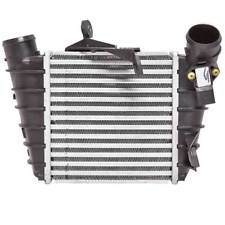
What is an intercooler? An intercooler is the heat exchanger that is tasked with cooling the air/intake charge on turbocharged vehicles, before it enters the inlet manifold. When the intake charge is compressed by the turbo, it heats up, and when this compressed and subsequently heated air passes through the intercooler, the heat is transferred via the tubes and fins of the intercooler into the passing ambient air. Once the intake charge exits the intercooler, it is coder and more dense which leads to more power and better volumetric efficiency from the motor. The colder intake charge also helps lessen the risk of harmful detonation/knock in the motor.
As fuel prices continue to rise, consumers are looking for more fuel efficient vehicles but also don’t want to sacrifice on vehicle performance. More and more vehicle manufacturers are turning to forced induction to satisfy these changing needs, these days almost all vehicle brands will offer at least one model of car that uses turbocharging, and almost all modern diesels are turbocharged as well. Using a turbocharged motor allows manufacturers a good compromise, the motors can be made smaller and thus will use less fuel, but will still be capable of the power and performance of the older and larger capacity naturally aspirated engines. Another added benefit is that the driver will feel less loss of power when using the car at altitude, for example the vehicle will not feel drastically less powerful up in Johannesburg compared to sea-level Durban.
On production vehicles, the most common type used is the air-to-air intercooler. These are usually mounted at the front of the vehicle just inside the front bumper, or occasionally on top of the motor underneath a bonnet scoop. This is because they rely on ambient air flowing through the core of the intercooler to cool intake temperatures. An air-to-air intercooler is usually a fairly efficient design. 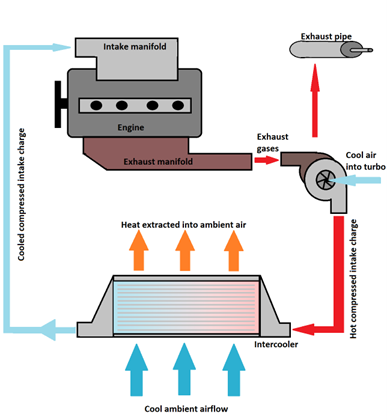 Most OEM and aftermarket intercoolers will have an aluminium tube-and-fin core, with plastic end tanks that are crimped in-place onto the core. Performance vehicles will sometimes use a bar-and-plate core with aluminium end tanks for higher performance and to withstand higher boost pressures.
Less commonly used is the liquid-to-air type intercooler, sometimes referred to as a charge cooler. These are far more complex to manufacture and install, but due to their efficiency and design they can be mounted anywhere in the engine bay, not tucked into the front bumper. The heat of the intake charge is not transferred into passing ambient air, but rather into the vehicles coolant. The air and coolant do not make contact as they pass through different channels in the charge cooler, the coolant is pumped through channels around the tubes that carry the intake air. Apart from the complexity of manufacturing a charge cooler, it will require extra coolant lines, sometimes an auxiliary coolant pump and even and additional radiator.

There are some common faults that may require you to replace your vehicles intercooler, such as small leaks from stone chips, inefficient cooling when either the inside of the cooler becomes soiled over time (usually caused by oil vapours from a leaky turbo seal or excessive crank-case breathing) or the outside becomes clogged with grass and road grime beyond the point of being cleaned, or even after damage from an accident.
If the cooler is blocked up (either by debris outside or excessive oil inside) it will operate less efficiently and in the long run this will cause higher fuel consumption, a loss of performance and possible engine damage.
If an intercooler has a leak it should be replaced as soon as possible, driving the vehicle with a boost leak will result in turbo wear or failure as the turbo has to work harder and harder to try achieve the desired boost pressures, and can often exceed its own maximum safe RPM.
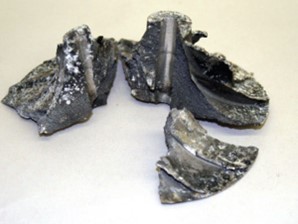
If a vehicles turbocharger has suffered severe mechanical failure, the intercooler should also be replaced. The compressor wheel of a turbo can spin at up to 150,000 RPM and usually this wheel will shatter when the turbo
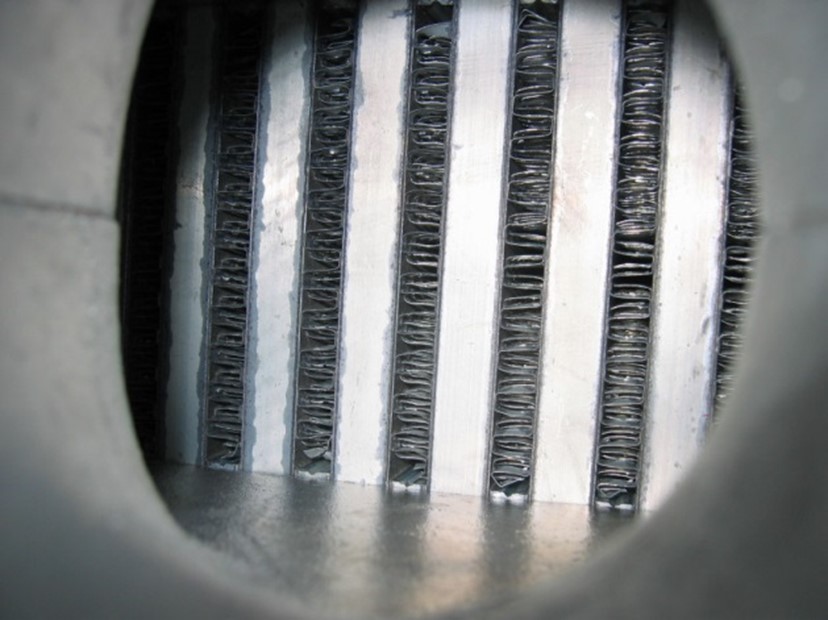 fails, send shards of steel or aluminium through the boost piping of the vehicle, which will usually gather somewhere within the intercooler. In some cases a specialist workshop could attempt to clean the intercooler, but the cost of this cleaning usually isn’t much cheaper than replacing the intercooler with a quality aftermarket part, and there is no 100% guarantee that all the metals shards will be removed by the cleaning. If a shard is left behind after cleaning, it can become dislodged during later use and will continue its path through the boost pipes of the vehicle, resulting in another turbo failure if the shard enters the turbo, or possibly even causing major engine damage if the shard of metal lodges itself on the piston face or between a valve and valve seat. It should also be noted that due the internal design of the tubes on some intercoolers (those with turbulator fins for example) cleaning is simply not possible.
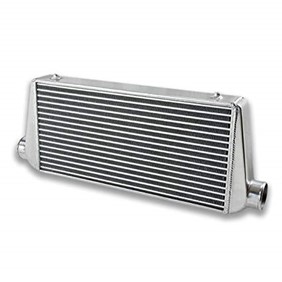 Careful consideration of the intercoolers capabilities should be taken when modifying your vehicle for performance. Increasing an engines power is no longer the dark science known only to a few, these days it is all too easy to change the software on a vehicles ECU to increase turbo boost pressures and adjust fuelling and timing to match. Most factory-turbo vehicles will be fitted with an aluminium and plastic intercooler, and these can only handle a certain amount of boost pressure, if one modifies their vehicle to produce higher boost pressure than what the intercooler can handle it will cause the plastic end tanks to be blown off of the intercooler. This cannot be repaired, and could cause further consequential damages. It would be a smarter choice to limit the modifications to a reasonable level, or to consider upgrading the intercooler to suit, either by fitting one from a similar vehicle that comes from the factory with more performance, or to use a custom built intercooler made entirely of aluminium.
In conclusion, turbocharged- and intercooled vehicles are becoming more and more common on our roads, and chances are you will own one at some point, it could be anything from a small one-litre sub-compact right up to a fire breathing top of the food chain performance sedan. A little bit of knowledge can go a long way, and hopefully you now have a better understanding of the function and importance of something as seemingly simple as your intercooler. Your vehicle is likely one of your most expensive assets, and this could save you money in the long run, from simple daily fuel savings achieved by a happy healthy car, to avoiding costly and unforeseen engine repairs.
Intercooler basics ignore for SEO purposes Grandmark productsSmart Web Designs